INTERNAL CONTROL · APPROVALS
Every franc approved at the right level, before it reaches the books.
Whoever records does not approve. Above a threshold, management steps in. And nothing is sealed before the last approval.
A gate before the entry, never on it.
- Segregation of duties Whoever records does not approve. An override is possible, never silent: it goes to the report.
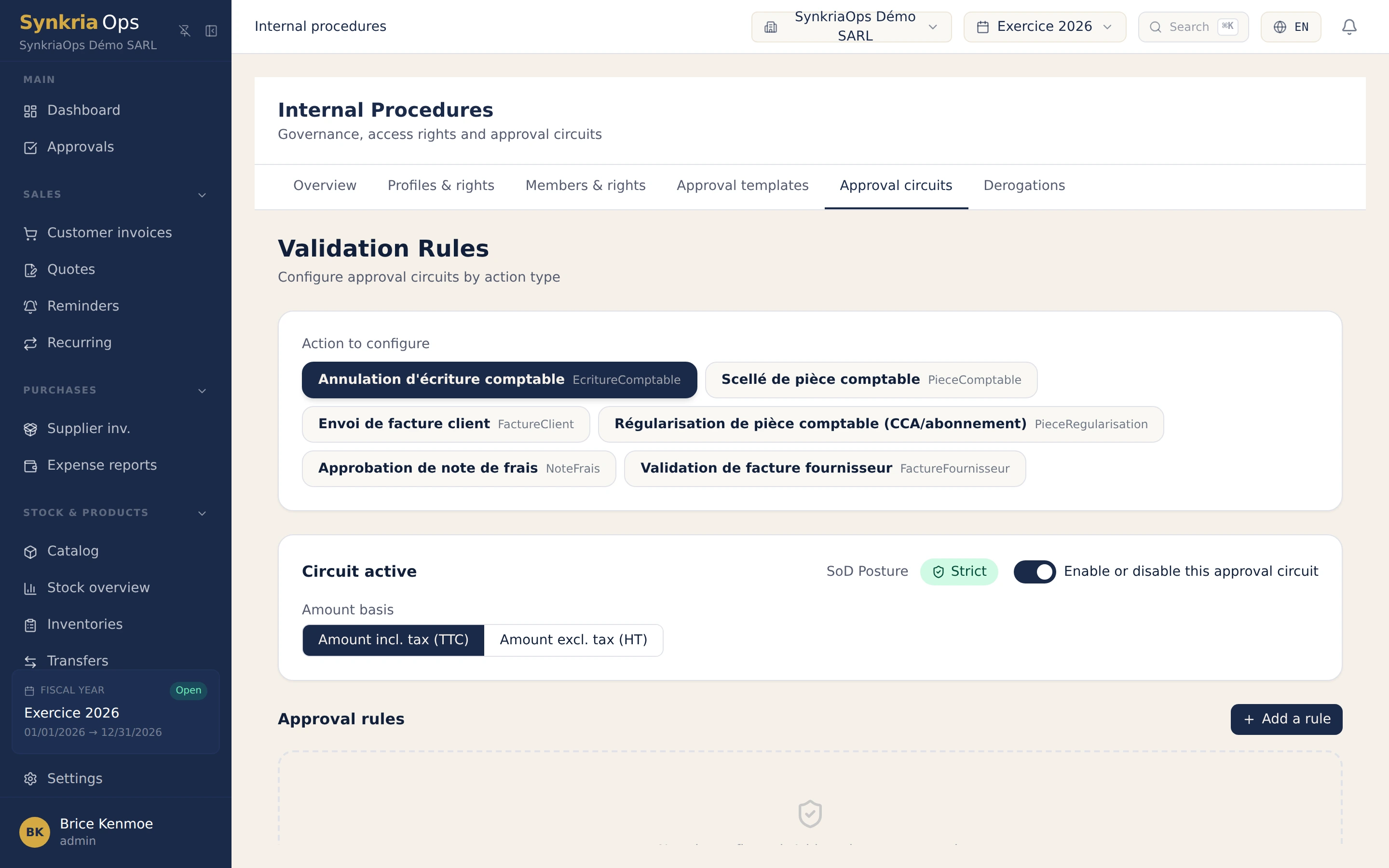
- Threshold delegation Below an amount, a manager is enough; above it, management. On the gross or net amount, your choice.
- Nothing sealed before While a request waits, the document is not sealed, sent or paid.
- Over twenty ready templates Purchases, treasury, sales, expenses, fixed assets: one click to enable, inactive otherwise.
Internal control: your questions
Do approval workflows block work if I don't configure them?
No. The engine is declarative: without configuration nothing changes and the action is sealed directly. Templates arrive inactive; you enable only the ones you need.
Which actions can require approval?
Sealing an accounting document, cancelling an entry, validating a supplier invoice, sending a customer invoice, an expense report, an adjustment, payments and cash or bank movements, disposing of a fixed asset and writing off a receivable.
Does an approval change the accounting entry?
No. Approval happens upstream of sealing: the integrity seal and entry immutability stay intact. The real effect (seal, sending, payment) only fires at the last approval.
Can segregation of duties be overridden?
Yes, if your rights allow it, but never silently: every override is recorded in an exportable override report, with a posture indicator.
How do approvers handle requests?
In their approvals inbox: for each request they approve, reject, recall or override according to their rights. While it waits, the action stays frozen.
Ready to approve every franc at the right level?
The audit maps your thresholds and approvers; we enable the workflows with you. In production, our access to your data is cut off.