SYSCOHADA REVISED 2019 · NORMAL SYSTEM
The Normal System, SYSCOHADA's default regime.
Balance sheet, income statement, cash-flow statement, statement of changes in equity and 47 notes: the full set of statements required by SYSCOHADA revised 2019 for most companies in the OHADA zone.
The Normal System applies to any entity that exceeds the turnover thresholds of the Système Minimal de Trésorerie (SMT) set by article 13 of the AUDCIF (Acte uniforme relatif au droit comptable et à l'information financière): roughly 60 million FCFA for very small trading businesses, 40 million for craft entities, and 30 million for service entities, with slight variations across OHADA member states. It is the default regime for the vast majority of SMEs and every structured company. An entity eligible for the SMT can also choose the Normal System by option, for example to prepare a fundraising round or a certification.
The full set of statements, generated from your entries
Four regulatory statements and 47 notes, produced automatically by SynkriaOps.
Balance sheet and income statement
TFT and TVCP
47 notes
Cover page and R1/R2/R3 sheets
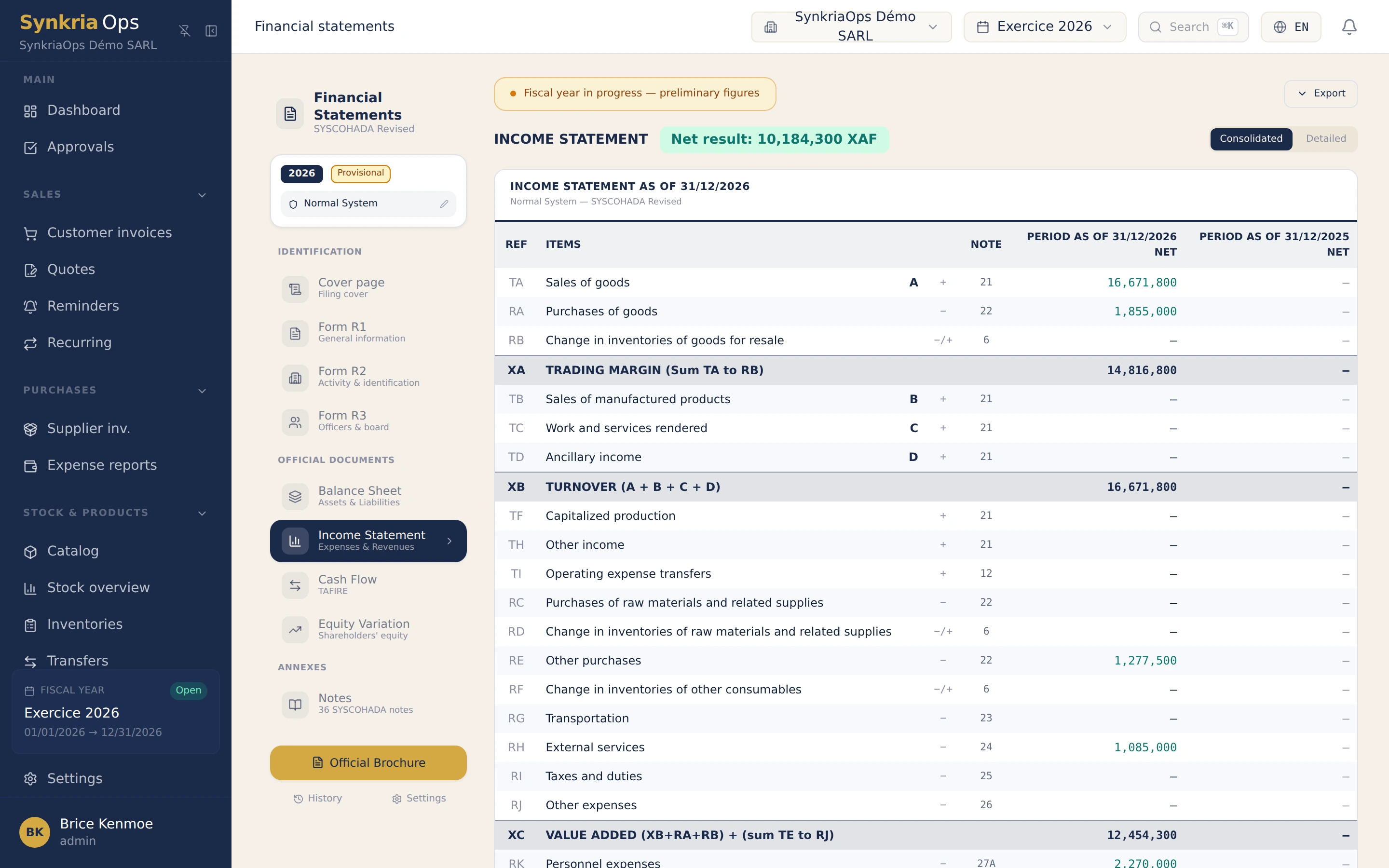
The income statement, SYSCOHADA format.
Trading margin, turnover, value added: the regulatory intermediate management balances, computed from your entries.
Why trust us
SYSCOHADA notes generated automatically with your financial statements.
- SYSCOHADA revised 2019
- NF203 standard
- Full isolation between files
- FEC export
- Sealed, tamper-proof entries
Normal System: your questions
Thresholds, required statements, difference with the SMT: what OHADA companies ask us.
Who must use the Système Normal (Normal System)?
Any entity whose annual turnover exceeds the thresholds of the Système Minimal de Trésorerie (SMT) set by article 13 of the AUDCIF: roughly 60 million FCFA for very small trading businesses, 40 million for craft and similar entities, and 30 million for service entities (thresholds vary slightly across OHADA member states). An entity eligible for the SMT may also opt for the Normal System voluntarily.
Which financial statements does the Normal System require?
The full set defined by SYSCOHADA revised 2019: the balance sheet (assets and liabilities), the income statement, the cash-flow statement (TFT), the statement of changes in equity (TVCP) and the 47 numbered notes, plus the cover page and the R1, R2, R3 identification sheets of the bundle.
What is the difference with the Système Minimal de Trésorerie (SMT)?
The SMT is a lighter regime reserved for small entities: a simplified balance sheet, a receipts-and-payments income statement and only notes S1 to S4, built on cash accounting. The Normal System requires the four full statements and the 47 notes, on an accrual basis. Details are on our dedicated SMT page.
Can the system be changed mid-fiscal-year?
No, neither in SynkriaOps nor in accounting practice: the chosen model (Normal System or SMT) locks as soon as the first financial statement is generated for the fiscal year. The choice is made at the opening of the year, in the tenant's accounting settings.
Does SynkriaOps generate the Normal System statements automatically?
Yes. Balance sheet, income statement, TFT, TVCP and the 47 notes are produced from your validated entries, with the standard's balance controls built in. Every line stays traceable to the source voucher.
More pages on financial statements
Normal System, SMT and notes: three regimes, one generation engine.
Système Minimal de Trésorerie (SMT)
The 47 notes
Financial statements overview
SYSCOHADA accounting
Back to all features.
Ready to generate your Normal System statements in one click?
14-day free trial, no credit card, supported by our team. Your financial statements, generated from your entries.