AUDCIF ART. 13 · LIGHTWEIGHT REGIME
The Système Minimal de Trésorerie, for small entities.
A simplified balance sheet, a receipts-and-payments income statement and notes S1 to S4: the lightweight accounting regime of SYSCOHADA revised 2019, reserved for entities under certain turnover thresholds.
Article 13 of the AUDCIF reserves the SMT for entities whose annual turnover (excluding tax) stays under thresholds that vary by activity: roughly 60 million FCFA for very small trading businesses, 40 million for craft and similar entities, and 30 million for service entities. These thresholds may vary slightly across OHADA member states. Unless it opts for the Normal System, an entity under these thresholds falls under the SMT: its accounting is based on cash movements rather than recognized receivables and payables.
A deliberately lighter set of statements
Fewer statements, fewer notes, but the same balance controls as the Normal System.
Simplified balance sheet
Receipts-and-payments income statement
Notes S1 to S4
Switch with no re-entry
One setting, Normal System or SMT.
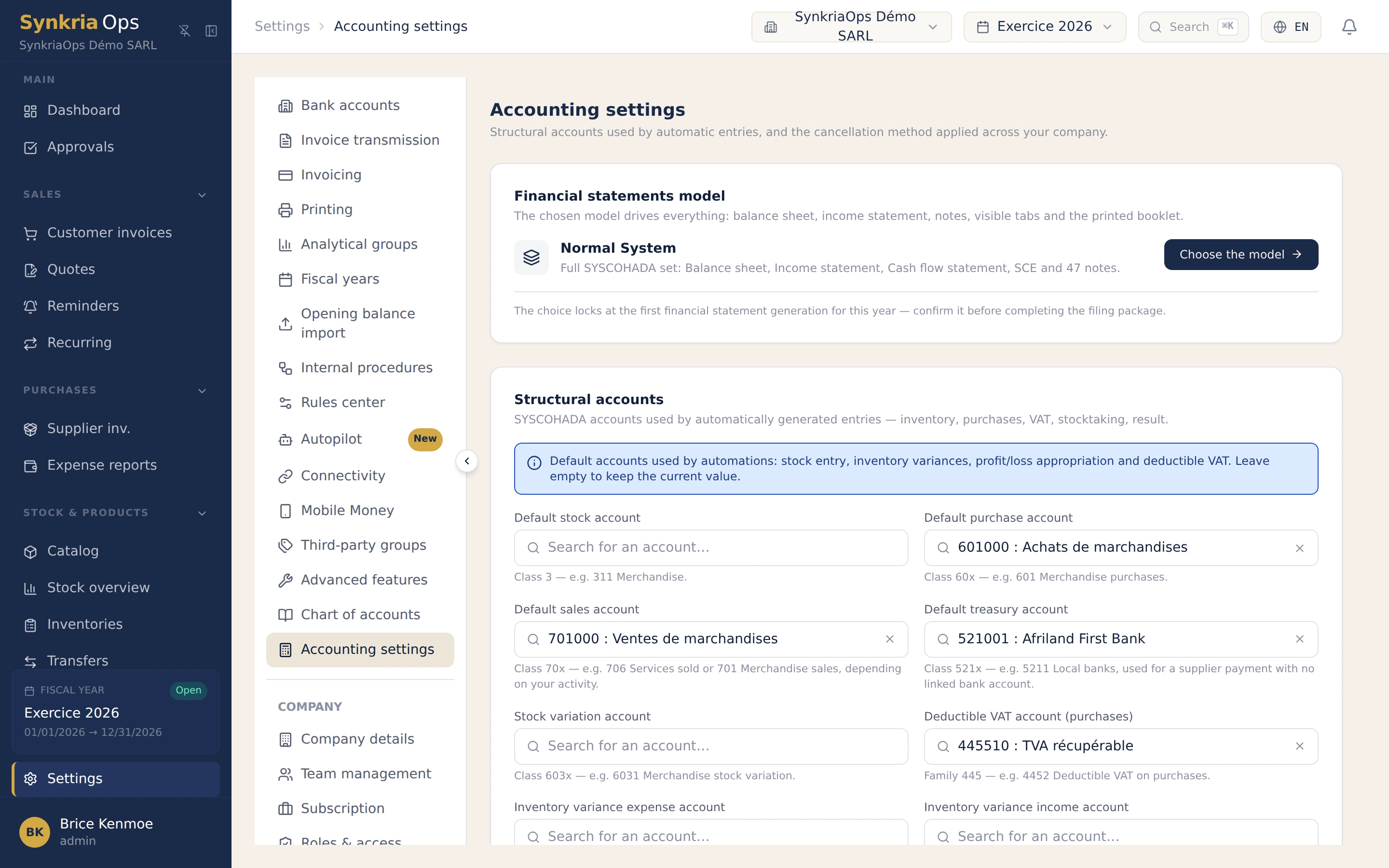
The financial-statement model is chosen in the tenant's accounting settings — no double entry, no manual switch.
Why trust us
SYSCOHADA notes generated automatically with your financial statements.
- SYSCOHADA revised 2019
- NF203 standard
- Full isolation between files
- FEC export
- Sealed, tamper-proof entries
SMT: your questions
Thresholds, notes S1 to S4, opting for the Normal System: what small OHADA entities ask us.
What is the Système Minimal de Trésorerie (SMT)?
The SMT is the lightweight accounting regime set out in article 13 of the AUDCIF (Acte uniforme relatif au droit comptable et à l'information financière) for small entities in the OHADA zone. It runs on cash accounting rather than accrual accounting, and only requires a simplified balance sheet, a receipts-and-payments income statement and notes S1 to S4.
Who is eligible for the SMT?
Entities whose annual turnover (excluding tax) stays under the thresholds set by the AUDCIF: roughly 60 million FCFA for very small trading businesses, 40 million for craft and similar entities, and 30 million for service entities. These thresholds may vary slightly across OHADA member states. The SMT applies by default unless the entity opts for the Normal System.
Which statements does an SMT entity produce?
A simplified balance sheet, a receipts-and-payments income statement, and notes S1 to S4 — far shorter than the 47 notes and four statements of the Normal System. In SynkriaOps, the cover page and entity identification stay mandatory; the other bundle sections become optional.
Can an SMT-eligible entity choose the Normal System instead?
Yes, that option is available: an entity under the thresholds can prefer the Normal System, for example to prepare a fundraising round, an audit or a certification that requires the full set of statements. The choice is made at the opening of the fiscal year and locks once the first statement is generated.
Does SynkriaOps handle the SMT natively?
Yes. The financial-statement model (Normal System or SMT) is chosen in the tenant's accounting settings. Under SMT, the application automatically adapts the available tabs, the notes shown and the generated brochure — no extra configuration needed.
More pages on financial statements
Normal System, SMT and notes: three regimes, one generation engine.
SYSCOHADA Normal System
The SYSCOHADA notes
Financial statements overview
SYSCOHADA accounting
Back to all features.
Ready to run your SMT without unnecessary complexity?
14-day free trial, no credit card, supported by our team. The statement model that matches your company's size.